
Enjoy these breathtaking galaxy space photos by NASA/ESA's Hubble Space telescope.

This object is a billowing tower of cold gas and dust rising from a stellar nursery called the Eagle Nebula. 7,000 light-years distant from us, the soaring tower is 9.5 light-years or about 90 trillion kilometers tall.
Stars in the Eagle Nebula are born in clouds of cold hydrogen gas that reside in chaotic neighbourhoods, where energy from young stars sculpts fantasy-like landscapes in the gas. The tower may be a giant incubator for those newborn stars. The column is silhouetted against the background glow of more distant gas. The bumps and fingers of material in the center of the tower are examples of stellar birthing areas. These regions may look small but they are roughly the size of our solar system. The red color in the lower region is from glowing hydrogen, the blue colour at the top is from glowing oxygen,
"If you want to see a black hole tonight, tonight just look in the direction of Sagittarius, the constellation. That's the center of the Milky Way Galaxy and there's a raging black hole at the very center of that constellation that holds the galaxy together."
(Michio Kaku)
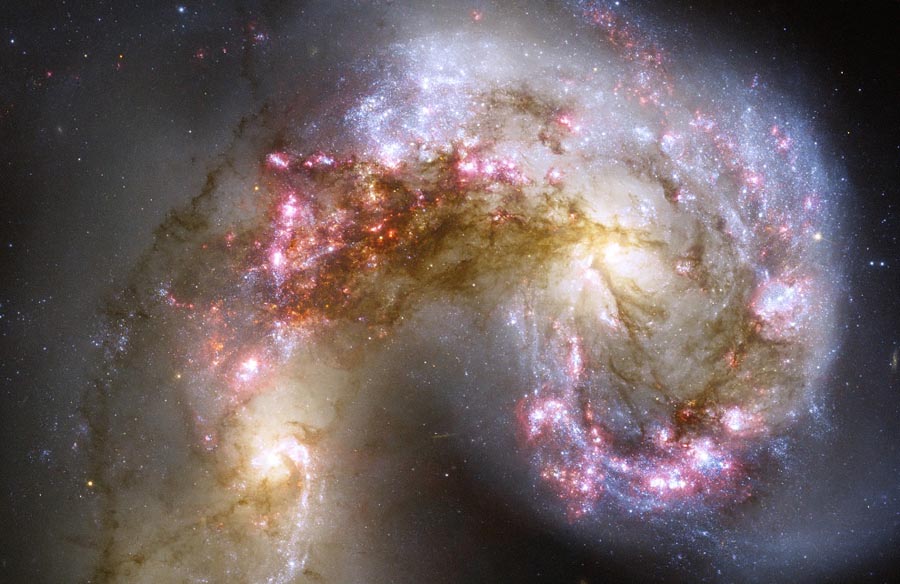
Also around 55 million light-years distant, we see here the colliding Antennae Galaxies – a pair of interacting galaxies that lie in the constellation Corvus. A few hundred million years ago, the two spiral galaxies started to fuse together. The Antenna galaxies are the nearest and youngest example of a pair of colliding galaxies. Nearly half of the faint objects in the Antennae are young clusters containing tens of thousands of stars.
A new Hubble image of the Antennae galaxies is the sharpest yet of this merging pair of galaxies. Billions of stars are born when two galaxies smash together, mainly in groups and clusters of stars. The brightest and most compact of these are called super star clusters.
"Looking up and out, how can we not respect this ever-vigilant cognizance that distinguishes us: the capability to envision, to dream, and to invent? the ability to ponder ourselves? and be aware of our existence on the outer arm of a spiral galaxy in an immeasurable ocean of stars? Cognizance is our crest
(Vanna Bonta)
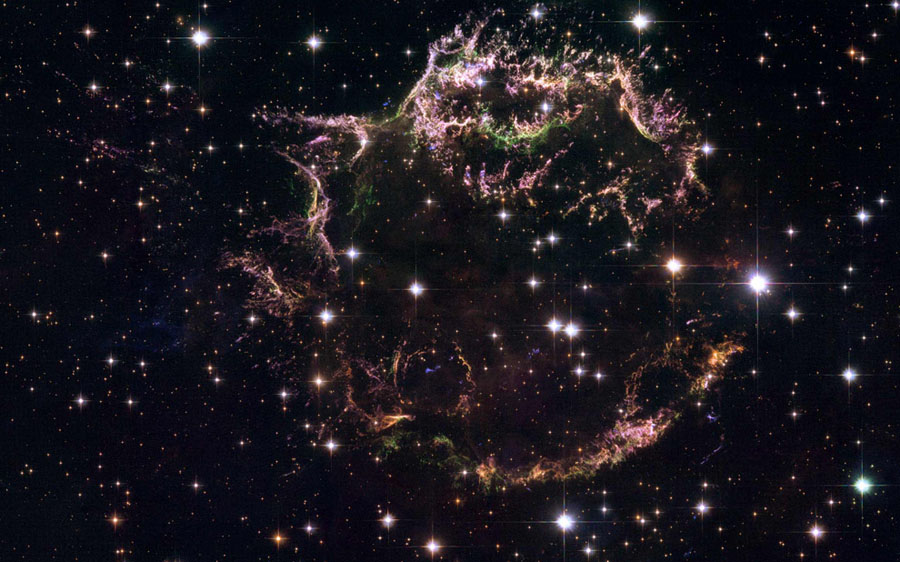
Cassiopeia A: The tattered remains of the youngest known remnants from a supernova explosio in the Milky Way.
A new image taken with the NASA/ESA Hubble Space Telescope provides a detailed look at the tattered remains of a supernova explosion known as Cassiopeia A (Cas A). It is the youngest known remnant from a supernova explosion in the Milky Way. The new Hubble image shows the complex and intricate structure of the star's shattered fragments.
"We're electrical items and when we die the electricity goes somewhere else. When we die our energy goes into the galaxy."
(Dominic Monaghan)
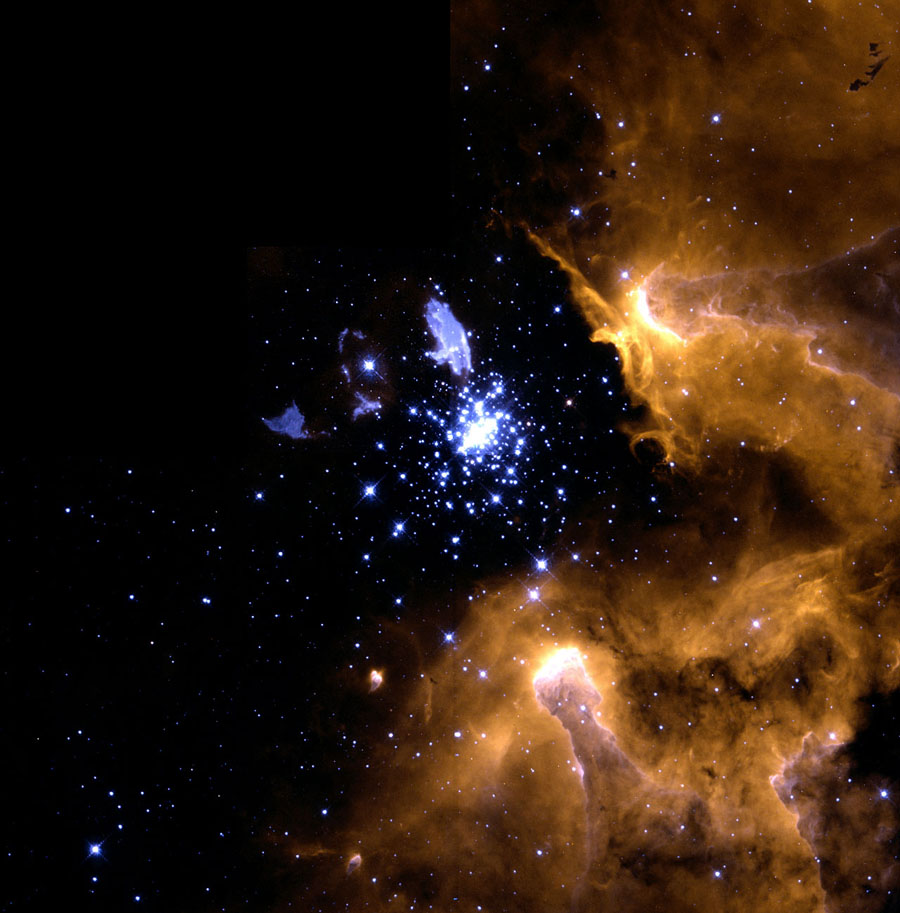
In this stunning picture of the giant galactic nebula NGC 3603, the crisp resolution of the NASA/ESA Hubble Space Telescope captures various stages of the life cycle of stars in one single view.
"When you look at the stars and the galaxy, you feel that you are not just from any particular piece of land, but from the solar system."
(Kalpana Chawla)
Want more unbelievable vastness and glittering stars? Other space galaxy photos can be enjoyed on: Spacetelescope.org
Jawohl Dierkikali,
diese ganz gewaltige menge an raum gefüllt mit galaxien schwebt im leeren nichts…
Shalom!
jetzt geht`s aber los hier… und trotzdem nichts zu finden… haha
Breathtaking, isn’it!?
And the most incredible fact is…: All those galaxies in space appear within YOUR inner space…
Enjoy yourSELF!
love the pictures, just took me on an incredible mind and wandering journey.
so enormous this energy we exist with, so mind blowing! so much we are so very unaware of! imagine what is right in front of our eyes but we are not even capable of seeing it.
I have to make one of these pictures my desktop background now.